How to Choose a Puzzle Book for a Senior with Low Vision
A puzzle book that looks fine on a store shelf can still be nearly unreadable for someone with low vision. Here's what actually matters before you buy one — for a parent, a grandparent, a care home resident, or anyone whose eyesight has changed.
Why "large print" on the cover isn't enough
Plenty of puzzle books print the words "large print" somewhere on the cover without actually changing much about the interior. A publisher might bump the font from 10-point to 12 or 14-point and call it done — technically larger, but still too small for many readers with age-related vision changes, macular degeneration, or other low-vision conditions.
The fix is simple: don't take the label at face value. Look at an actual sample page, or check the listing description for a specific point size, before assuming the book will work.
What to actually check before buying
Quick checklist
- Type size: 18-point minimum, 24-point is noticeably better
- Contrast: solid black ink on plain white or cream paper, not gray or light-colored text
- Grid spacing: letters and cells with visible white space between them, not crammed edge to edge
- Puzzle type: word searches and simple mazes read easier than dense crosswords or tiny sudoku grids
- Paper finish: matte, uncoated paper to cut down on glare
- Answer key included: so a hard-to-read letter can be double-checked
Type size and contrast
Type size gets most of the attention, but contrast matters just as much. A large font printed in light gray ink, or set against a busy background pattern, can be just as hard to read as small black text on white. The clearest combination is still the simplest one: solid black ink on plain white or cream paper.
Grid spacing, not just letter size
For word search and similar grid-based puzzles, the space between letters matters as much as the size of each letter. A grid where every square touches its neighbor can blur together for a low-vision reader, even if the individual letters are large. Look for a grid with visible breathing room between rows and columns.
Puzzle type: some are just easier to read than others
Not every puzzle format is equally forgiving. A word search is usually the easiest starting point — solid grid, uniform letter size, no small numbers or multiple overlapping clue directions to track. Crosswords and number puzzles like sudoku tend to pack more information into a smaller visual space, which can work against a low-vision reader even in an otherwise well-printed book.
An example that gets this right
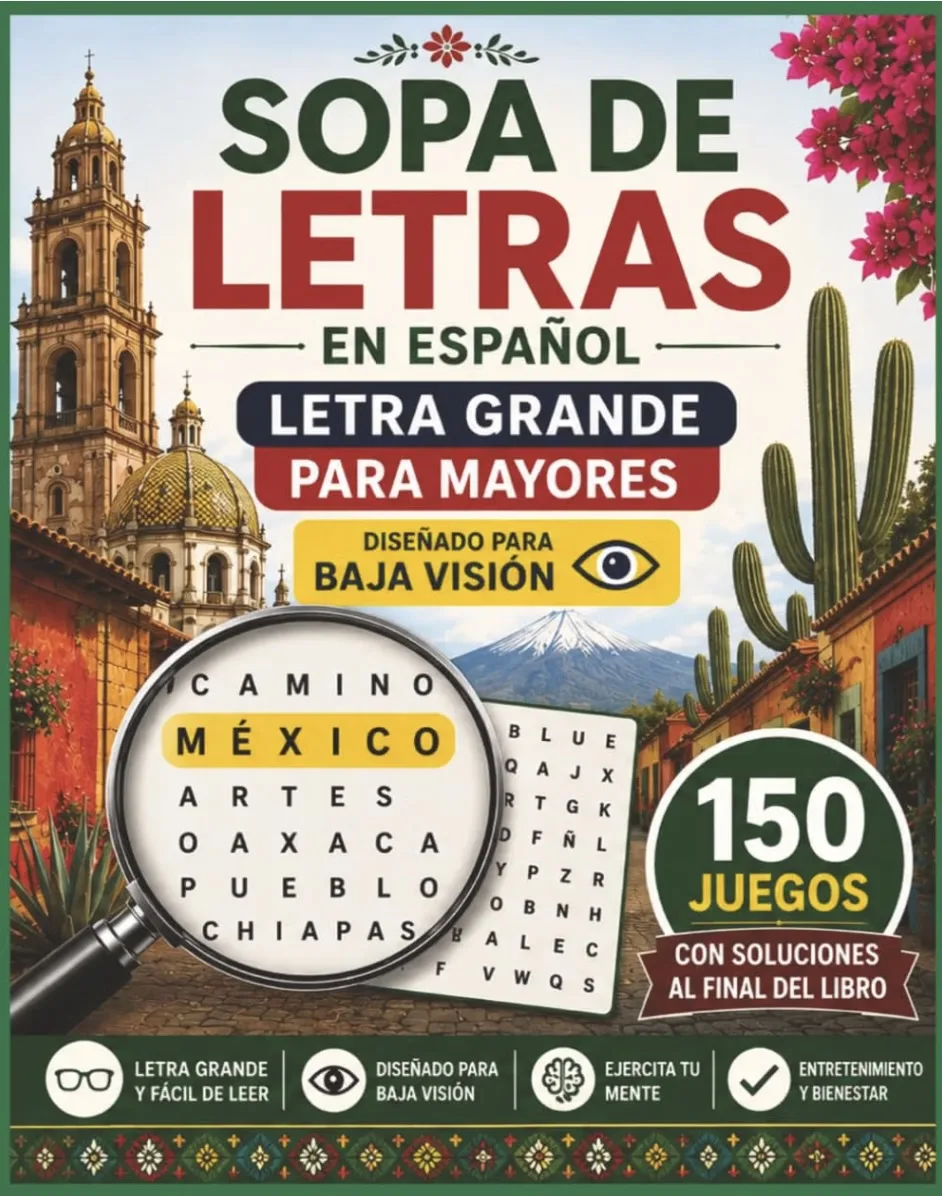
Our own Sopa de Letras en Letra Grande was built specifically around these criteria: large, high-contrast letters, generously spaced grids, and a straightforward word search format rather than a denser puzzle type. It's a Spanish-language title with a Mexican culture theme, designed for seniors with low vision who read in Spanish.
Sopa de Letras en Letra Grande
150 word search puzzles with Mexican culture themes, printed in extra-large, high-contrast type with generously spaced grids.
If you're looking at our full range of large-print options rather than this one title, our large-print puzzle books page covers what's currently available.
Frequently Asked Questions
What font size counts as "large print" for a puzzle book?
Look for at least 18-point type, with 24-point being noticeably more comfortable for most readers with low vision. Some books labeled "large print" only bump the size slightly above standard 10–12 point text, so it helps to check the actual point size rather than trust the label alone.
Is a word search or a crossword easier for someone with low vision?
Word searches are generally easier, since the grid uses large, evenly spaced individual letters rather than small numbered boxes with multiple intersecting answers. A crossword's clue-and-grid format also requires more back-and-forth eye movement, which can be tiring for low-vision readers.
Does paper type matter for a low-vision reader?
Yes. Matte, uncoated paper reduces glare compared to glossy paper, which can reflect light and make text harder to read, especially under bright overhead lighting.
What if the puzzle book doesn't include an answer key?
Skip it. Without an answer key, a low-vision reader has no way to confirm a hard-to-see letter or check their work, which turns a relaxing activity into a frustrating one.
Buying for a Care Home or Activity Group?
We're happy to help with bulk orders and recommendations for care homes, senior centers, or activity coordinators.
Contact Aberoc Books